
(Wait for the replay...)
Saturday, October 3, 2009

Friday, September 25, 2009
O'Hair Fires Disappointing Second-Round 81
 After opening with a 66 and storming into the lead at the TOUR Championship yesterday, Sean O'Hair followed-up with a disappointing 81 today at East Lake Golf Club outside of Atlanta, Georgia.
O'Hair inexplicably failed to get up-and-down a single time today, depite narrowly missing the green at numbers 2, 7, 11, 13 and 18. With only 26 putts on the round, O'Hair's stellar run with the flatstick continued after being spotted taking some pre-round putting advice from world number one Tiger Woods yesterday. However, it was not enough to overcome his short game woes, as he continually overshot greens with short pitches.
"I just could not not find the green with a chip all day long," O'Hair said, "My hands felt fidgety on the club and I couldn't get comfortable over the ball on my bump-and-run shots."
The scene on the 11th green epitomized O'Hair's afternoon. He stubbed two pitches with a sand-wedge before switching to a 9-iron and sending his ball cascading through the green and into the gallery. He took an 11 on the hole, effectively ending his chances at the title and its potential accompanying $10 million prize.
"I have no idea what got into me. I had a great practice session before the round and even had time to go over some short game game ideas with Phil [Mickelson] before I teed off," O'Hair said, in reference to a conversation he had with Mickelson beside East Lake's practice green shortly before his 12:00 tee time.
Mickelson, himself, shot 68 on the day, overcoming yesterday's lackluster 73, which was highlighted by several shanks and flubs on number 8, leading to an unpleasant score of 8.
Tuesday, September 22, 2009
Just a thought...
By now you've surely seen the newest Nike football commercial featuring Adrian Peterson. You know, the one where he runs around the field, baffling the opposition and perplexing its coaching staff, in the driving sleet, in black and white, before retiring into the locker room to undress and display his hexagon-scaled skin, all in an effort to promote the Nike Pro Combat line of compression-wear football equipment that features strategic hexagonal padding??
You've seen it, it's highly theatric, in keeping with Nike's recent marketing practices, which makes me wonder if that is actually Peterson hurdling, sidestepping and causing oxygen deficiency in defenders, or if a stuntman is filling in and we are deceived by some professional camera work.
Think about it. That field is sloppy (presumably to demonstrate the Nike frontman's capacity to endure the elements and succeed, while his inferiorly-clad opponents resign to sit on their helmets and suck oxygen from O2 tanks). But would the Vikings, who are investing $2.85 million a year (plus massive incentives) into their workhorse, allow Peterson to trot around, even making pre-conceived cuts on that playing surface, among twenty-one other padded actors, all of whom could potentially take a mis-step and roll up on his leg? Doesn't seem very likely.
So that begs the question... what are we seeing in the commercial? Is it a stunt-Peterson? Or is the director exploiting slow-motion technology that somehow lets Adrian Peterson run in complete safety? Or is it some other Hollywood movie trick? I guess none of it really matters, because he came away healthy, but the commercial does make you wonder how much control teams have over their players, especially face-of-the-franchise type guys like A.P.
(Take a look at the video on Youtube: http://www.youtube.com/watch?v=_xQF2XDsswg)
You've seen it, it's highly theatric, in keeping with Nike's recent marketing practices, which makes me wonder if that is actually Peterson hurdling, sidestepping and causing oxygen deficiency in defenders, or if a stuntman is filling in and we are deceived by some professional camera work.
Think about it. That field is sloppy (presumably to demonstrate the Nike frontman's capacity to endure the elements and succeed, while his inferiorly-clad opponents resign to sit on their helmets and suck oxygen from O2 tanks). But would the Vikings, who are investing $2.85 million a year (plus massive incentives) into their workhorse, allow Peterson to trot around, even making pre-conceived cuts on that playing surface, among twenty-one other padded actors, all of whom could potentially take a mis-step and roll up on his leg? Doesn't seem very likely.
So that begs the question... what are we seeing in the commercial? Is it a stunt-Peterson? Or is the director exploiting slow-motion technology that somehow lets Adrian Peterson run in complete safety? Or is it some other Hollywood movie trick? I guess none of it really matters, because he came away healthy, but the commercial does make you wonder how much control teams have over their players, especially face-of-the-franchise type guys like A.P.
(Take a look at the video on Youtube: http://www.youtube.com/watch?v=_xQF2XDsswg)
The ACC and the Summer of '04

The ACC logged its biggest win of the young season when Florida State knocked off seventh-ranked BYU in Provo, Utah this Saturday. Think about that… FSU defeating a Mountain West team today is seen as an impressive feat. It’s a fact that demonstrates the sad state of the Atlantic Coast Conference in its current form, a far cry from the mega-conference the ACC felt it was becoming in the summer of 2004.
Let me take you back, back to July 2004. George W. Bush boasts a 51% approval rating and seeks a second term of office. The Nelly song, “Over and Over Again” with Tim McGraw is getting considerable radio airtime, Facebook is four months old and the ACC is a respectable athletic conference best known for its sterling academic reputation.
In July of ’04 ACC Commissioner John Swafford organizes efforts to entice perennial Big East juggernaut Miami and burgeoning, defensive-minded Virginia Tech to ally with the conference and elevate the ACC into a venerated regional power poised to challenge the SEC, Big 10 and Big 12.
It was an impressive move. And you were hard pressed to find a critic who felt the annexation did anything but make the ACC an immediate BCS power broker. Va. Tech was building an impressive resume, with four recent BCS bowl invites and a national title game appearance. Miami added five national title claims to the conference coffers and an instantaneous rivalry with Miami, certain to curb national attention. The addition of the two new schools gave the ACC a total of twelve, the magic number needed to institute a conference championship game, and an automatic media spotlight. How could the conference go anywhere but up?
Back to the current day, a Wake Forest ACC championship and two Boston College runners-up later, and the conference has become a yearly disappointment. Florida State and Miami, the conference’s cornerstones, have fallen from influence. The ACC title game has been dismally attended and the venue shifted. We are still waiting for the conference’s pre-ordained resurgence. Where’s the yearly national title contender? Where are the prime time rivalry games and new, intriguing matchups brought on by the addition? Raycom Sports, that’s where. The SEC and Big 12 have clearly stepped up as the game’s top conferences. The Big 10 has put two Ohio State teams into the BCS title game since. And the Pac 10 can at least boast USC, its ’04 title and ’06 appearance.
And what does the ACC have to show for its machinations? The Big East is eviscerated. Talking heads are calling for its BCS tie-in to be revoked. And at what cost? The damage done to the Big East certainly isn’t justified by what the new ACC has accomplished, not by a long shot. And since these two BCS conferences cannot hold their own, we must suffer the constant boo-hooing of mid-majors purporting a claim to the national championship every season.
The damage is done, and there’s no going back. While the Big East has improved somewhat this season, its BCS privileges will continually be challenged. The ACC may not be far off from meeting the expectations of 2004, with Miami and FSU showing signs of revival, but the unavoidable truth remains that the annexations of ’04 have so far been a supreme disappointment.
Tuesday, August 18, 2009
Strasburg's Signing and Its Impact on Global Terrorism

The Nationals miraculously managed to come to terms with Steven Strasburg and mega-agent Scott Boras, the most accomplished negotiator this side of William Shatner, before last night's midnight deadline.
While the details of the deal have been released, as we all know, the numbers we see in the news do not encapture all the conditions of the agreement.
Take, for example, the ninety-some-odd million dollars on Eli Manning's recent contract. They represent the potential amount he can earn, but the majority of his compensation is incentives-based. What you see in print in most cases is not what the player actually gets.
Michael Vick was awarded the most lucrative contract in NFL history before an ill-advised business manuever landed him in a Virginia prison, and when he did not fulfill the incentives written into his contract, he didn't earn close to the amount shown on paper.
While MLB contracts typically represent the entire sum a player can expect to take home for the duration of the agreement, Stephen Strasburg's package contains more than meets the eye.
Strasburg's original list of demands, as interpreted by Scott Boras, consisted of nearly 100 million U.S. dollars. When the Nationals refused to comply with their requests, Strasburg and Boras did what all great movie hostage takers do when their ransom goes unpaid. They threatened and made further demands.
It just so happens that Strasburg is a loyal Soviet nationalist furious that his Mother Russia has been upstaged as the world's pariah state par-excellence by petty former U.S.S.R. parcels like Afghanistan. While the Nats could not raise enough money to satisfy his original cash demands, their key positioning in our nation's capital made the team an able but unlikely broker for goods of a more volatile nature... Soviet terrorists held over as enemies-of-state from the Cold War.
In accordance with Strasburg's second list of demands, which were relayed to him over the phone by Scott Boras through a voice distorter like the one in the Scream films, Nationals owner Mark Lerner immediately contacted the Pentagon to negotiate for the release of seven Soviet terrorists retained in the military prison at Guantanimo Bay, Cuba. Although Lerner had to give up season tickets to the Kennedy Center and was forced to fix the outcome of several of the Nats' now famous 6th inning President Runs, the Pentagon complied, satisfying the most stringent of Strasburg's demands.
Next, Lerner was forced to arrange a fuelled 747 to be prepped on the tarmac of the Havana airport to facilitate the transportation of the Soviet loyalists, along with a squadron of accompanying FA/18 Hornets to function as a protective envoy for the expatriates.
Once Lerner orchestrated the fireballing Strasburg's requests, he agreed to ink a nominal $15 million deal to help the Nats save face. Strasburg, content and optimistic that the terrorists will effectively be able to incite a second Cold War, reported to Rookie Ball in Des Moines this morning.
On a more serious note...
Here's an issue I take very seriously and some thoughts I have tried to instill in a few of my more hot-headed teammates. (I won't name any names, but I'm thinking of an individual whose surname rhymes with Shmarshletski.) Please take a look at Tom Verducci's intelligent write-up, MLB Needs to Curb Macho Culture, on the ludicrous game of bean-ball recounted seemingly every evening on Baseball Tonight. Now is a better time than ever to examine the current state of affairs, with the recent flash flood of cranial blunt-force trauma wounds inflicted on the diamond. Take a look at what Verducci has to say, and then, if you have absolutely nothing better to do, consider my analysis of the situation and suggestions for its correction, in the form of a response I just shot off to Mr. Verducci...
Excellent piece (MLB Needs to Curb Macho Culture). I can't think of anything less masculine than hurling a projectile at another man. And hitters only appear more ridiculous when they charge the mound in a fit of machismo, only to fling a batting helmet as a weapon, like Kevin Youkilis recently. I don’t know what initiated the present era of puffed up braggadocio, but with each MLB bullpen today carrying several pitchers capable of hitting the upper-90’s on the gun, a potentially tragic system of reciprocation and revenge has suddenly taken hold as the unavoidable status quo.
What will it take to bring an end to this cycle? It looks like all-star and franchise player David Wright may miss the remainder of the ’09 season. I can only hope he will recover the composure required to step back into the box and compete at his former level.
I used to think hockey’s ritual of condoned pugilism cheapened the game, but now I can see that it effectively provides forum for players to release frustration and settle disputes man-to-man, without access to weapons, and referees positioned to call off the fight when it has run its course.
A 95 MPH fastball is a weapon (see Julio Castillo, the minor leaguer who struck a fan in the head last year with a ball intended for the opposing bench in a dugout-clearing brawl and his since been charged with felony assault). This game of strutting around “protecting players” could very well result in the death or serious maiming of a party with no stake in the quarrel apart from the misfortune of sharing a uniform with a bone-headed vigilante reliever. What we see played out on a near-nightly basis is nothing more than schoolyard posturing with the unfortunate availability of deadly weapons.
It is widely acknowledged that we expect too much from our athletes. But they must be made to understand the magnitude of their actions. There is a time and place for the bean ball. But as every pitching coach worth his salt has taught, it belongs on the hitter’s back, never at his head. Until pitchers have demonstrated the capacity to make the ball go where they want it, they should not be permitted to take another individual’s life in their hands.
Umpires should not be charged with interpreting intent. They have their hands full on the field as it is. Perhaps a disciplinary panel consisting of former players should be established to rule on these incidents. And punishments should equal those in place for steroid use. Both infractions can potentially lead to severe physical harm and set a poor example for young fans of the game. The current culture is breeding youths who believe what they see on television is the big league way to play. The cycle must be broken before a new generation of head hunters ascends and the sport is ruined for good.
Excellent piece (MLB Needs to Curb Macho Culture). I can't think of anything less masculine than hurling a projectile at another man. And hitters only appear more ridiculous when they charge the mound in a fit of machismo, only to fling a batting helmet as a weapon, like Kevin Youkilis recently. I don’t know what initiated the present era of puffed up braggadocio, but with each MLB bullpen today carrying several pitchers capable of hitting the upper-90’s on the gun, a potentially tragic system of reciprocation and revenge has suddenly taken hold as the unavoidable status quo.
What will it take to bring an end to this cycle? It looks like all-star and franchise player David Wright may miss the remainder of the ’09 season. I can only hope he will recover the composure required to step back into the box and compete at his former level.
I used to think hockey’s ritual of condoned pugilism cheapened the game, but now I can see that it effectively provides forum for players to release frustration and settle disputes man-to-man, without access to weapons, and referees positioned to call off the fight when it has run its course.
A 95 MPH fastball is a weapon (see Julio Castillo, the minor leaguer who struck a fan in the head last year with a ball intended for the opposing bench in a dugout-clearing brawl and his since been charged with felony assault). This game of strutting around “protecting players” could very well result in the death or serious maiming of a party with no stake in the quarrel apart from the misfortune of sharing a uniform with a bone-headed vigilante reliever. What we see played out on a near-nightly basis is nothing more than schoolyard posturing with the unfortunate availability of deadly weapons.
It is widely acknowledged that we expect too much from our athletes. But they must be made to understand the magnitude of their actions. There is a time and place for the bean ball. But as every pitching coach worth his salt has taught, it belongs on the hitter’s back, never at his head. Until pitchers have demonstrated the capacity to make the ball go where they want it, they should not be permitted to take another individual’s life in their hands.
Umpires should not be charged with interpreting intent. They have their hands full on the field as it is. Perhaps a disciplinary panel consisting of former players should be established to rule on these incidents. And punishments should equal those in place for steroid use. Both infractions can potentially lead to severe physical harm and set a poor example for young fans of the game. The current culture is breeding youths who believe what they see on television is the big league way to play. The cycle must be broken before a new generation of head hunters ascends and the sport is ruined for good.
Wednesday, August 12, 2009
Bulldogs in Forbes
Forbes recently released this examination into which college football games will demand the highest ticket prices this season.
First on the list, no surprise, is USC at Notre Dame (10/17). Notre Dame has the nation's largest fanbase, most likely because the Catholic church frowns upon the use of contraception, and USC has the most popular college football team in the country's most populous state.
However, number two may raise some eyebrows.
Forbes reveals that ticket prices at every single University of Georgia game played at the team's home of Sanford Stadium in Athens, Georgia will eclipse the asking price of tickets for any other game in the 2009 season.
Which means the November 7th game against Tennessee Tech, even if the Dawgs limp in with three losses and no remaining BCS hopes, will demand a heftier sum than "The Red River Shootout," featuring two National Championship-caliber teams and a Heisman favorite in Colt McCoy. More than the heralded LSU-Florida matchup at Death Valley.
What conclusions can we draw from this revelation? Certainly that the level of enthusiasm for Georgia football surmounts that of any other team in the country, even in spite of the team's lackluster pre-season ranking (15th by Sports Illustrated).
And don't go looking at stadium capacity figures to argue that ticket scarcity could be an explanation for the exceptionally high ticket prices asked for Georgia games.
Sanford Stadium holds upwards of 92,000 people. The Cotton Bowl (site of OU-Texas) holds roughly the same amount (92,200) and Death Valley fills up to a similar 92,400.
I'm just presenting the facts as illuminated by Forbes. Don't let my UGA-bias sway you. Take a look at the numbers and draw conclusions for yourself. However, it sure is hard to argue that passion for Georgia football may very well be the most fervent in the nation.
First on the list, no surprise, is USC at Notre Dame (10/17). Notre Dame has the nation's largest fanbase, most likely because the Catholic church frowns upon the use of contraception, and USC has the most popular college football team in the country's most populous state.
However, number two may raise some eyebrows.
Forbes reveals that ticket prices at every single University of Georgia game played at the team's home of Sanford Stadium in Athens, Georgia will eclipse the asking price of tickets for any other game in the 2009 season.
Which means the November 7th game against Tennessee Tech, even if the Dawgs limp in with three losses and no remaining BCS hopes, will demand a heftier sum than "The Red River Shootout," featuring two National Championship-caliber teams and a Heisman favorite in Colt McCoy. More than the heralded LSU-Florida matchup at Death Valley.
What conclusions can we draw from this revelation? Certainly that the level of enthusiasm for Georgia football surmounts that of any other team in the country, even in spite of the team's lackluster pre-season ranking (15th by Sports Illustrated).
And don't go looking at stadium capacity figures to argue that ticket scarcity could be an explanation for the exceptionally high ticket prices asked for Georgia games.
Sanford Stadium holds upwards of 92,000 people. The Cotton Bowl (site of OU-Texas) holds roughly the same amount (92,200) and Death Valley fills up to a similar 92,400.
I'm just presenting the facts as illuminated by Forbes. Don't let my UGA-bias sway you. Take a look at the numbers and draw conclusions for yourself. However, it sure is hard to argue that passion for Georgia football may very well be the most fervent in the nation.
Tuesday, July 21, 2009
Favre Makes Decision

You heard it here first. Brett Favre has agreed to come to terms with the Minnesota Vikings... under the condition that Vikings brass allow him to play this season not in standard NFL uniform, but in his trusty frayed Nike Golf hat, a sleeveless worn out purple t-shirt with a faded number 4 on the front, muddy Nike Shox with low-cut black socks, and an option for either khaki cargo pants or Wrangler bluejeans (depending on gametime temperature).
Vikings management has scrambled to set up meetings with NFL commissioner Roger Goodell and Reebok president Michael Samuels tomorrow to bargain for permission to have a player so egregiously out of uniform.
Favre has also expressly requested that the Vikings sign his hometown pal Gus McKeen, the guy who made that awesome catch diving into the mud in Favre's most recent Wranglers commercial. Favre feels the Vikings need to add a sure-handed possession receiver into the mix to be a true playoff contender, not to mention a guy who's willing to lay out and get a little dirty in less-than-ideal playing conditions.
Furthermore, Favre is negotiating for exclusive playcalling rights over Minnesota's offensive coordinator Darrell Bevell. Favre's offensive genius is demonstrated clearly in that Wrangers commercial... of course I'm referencing the fake-reverse, no look pitch that completely duped the opposing defense and resulted in a key conversion on 3rd and 4. Apparently, Favre just drew that play up in the huddle, he says he has tons more razzle dazzle drawn up after months of experimenting with daughters Brittany and Breleigh and laborador retreiver Cooper in the backyard.
Tuesday, July 14, 2009
Bastille Day
France may be excited about Bastille Day, but I'd like to stifle those smelly Frenchies' excitement and remind the entire globe that the U.S. > France on any day. (Thanks for the help in that Revolutionary War, though.) For your patriotic enjoyment: WATCH HERE
Monday, July 13, 2009
Mid-Season Awards
The All-Star break is upon us and that can only mean one thing... Deucedbrains' inaugural Billy Scripture Memorial Mid-Season Awards. Sportswriters from across the nation have sent in their ballots, and our interns have calculated the results. Drumroll please...

The Rollie Fingers Award for Achievement in Facial Hair Growth by a Relief Pitcher goes to Arizona Diamondbacks rookie Clay Zavada. The sensational face-salad clinging to Zavada's upper lip speaks for itself. Who wants a mustache ride?

The Steven Shepherd Trophy for Inscrutable Mound Activity goes to Mets' pitcher Mike Pelfrey for his dumbfounding three balks in a May 16th loss to the Giants televised nationally on ESPN.
The 1-Man, No Cup Prize for Astonishing Willingness to Share Fecal Matter is awarded to Phillies' outfielder Raoul Ibanez, who proffered his stool (along with his urine, hair and blood... hopefully not mixed) to a blogger who suggested Ibanez's recent explosion in offensive production may be attributable to performance enhancing drugs.
The Geriatric Award, sponsored by Rascal Scooter Co., Inc. goes to Phillies' quadragenarian Jamie Moyer for his impressive effectiveness as a starter despite his old age. MLB may want to research the potential performance enhancing characteristics of a combination of Avadart, Levitra, Celebrex, Just for Men and over-the-counter ulcer medication.

The Deucedbrains Plaque for Stifling Proficiency in Getting One's Brains Deuced Out is awarded to Oklahoma City RedHawks' first-baseman Chris Davis. Davis struck out an impressive 114 times in 258 big league at-bats for the Rangers before being demoted to the minors. He did bang out 15 home runs however, meaning he either struck out or left the yard in exactly 50% of his AB's this year.
The Orbitz Gum "Dirty Mouth" Award goes to White Sox third-baseman Gordon Beckham for this slide into second base against the Royals on 4th of July weekend.
The Jason Kidd, Sickest No-Look Dish of the Half-Year is awarded to JU alum Daniel Murphy of the Mets for this web gem which sadly predated his benching.

Oakland A's pitcher Josh Outman walks away with two prestigious "Deucies." One for Most Uncannily Suitable Surname (with a name like that, he was born to get outs) and the Hoboken Knitting Society's Prize for Outstanding Hosiery in appreciation for his leg garmenting. While I am not the biggest fan of the A's yellow sanitaries, I do value Outman's efforts to bring the 6-inch stirrup back in vogue.
Well that's all we have for now. Winners, your prizes should arrive via DHL in the coming weeks. We are always accepting suggestions for further awards and will provide forum for your recommendations. Thanks!

The Rollie Fingers Award for Achievement in Facial Hair Growth by a Relief Pitcher goes to Arizona Diamondbacks rookie Clay Zavada. The sensational face-salad clinging to Zavada's upper lip speaks for itself. Who wants a mustache ride?

The Steven Shepherd Trophy for Inscrutable Mound Activity goes to Mets' pitcher Mike Pelfrey for his dumbfounding three balks in a May 16th loss to the Giants televised nationally on ESPN.
The 1-Man, No Cup Prize for Astonishing Willingness to Share Fecal Matter is awarded to Phillies' outfielder Raoul Ibanez, who proffered his stool (along with his urine, hair and blood... hopefully not mixed) to a blogger who suggested Ibanez's recent explosion in offensive production may be attributable to performance enhancing drugs.
The Geriatric Award, sponsored by Rascal Scooter Co., Inc. goes to Phillies' quadragenarian Jamie Moyer for his impressive effectiveness as a starter despite his old age. MLB may want to research the potential performance enhancing characteristics of a combination of Avadart, Levitra, Celebrex, Just for Men and over-the-counter ulcer medication.

The Deucedbrains Plaque for Stifling Proficiency in Getting One's Brains Deuced Out is awarded to Oklahoma City RedHawks' first-baseman Chris Davis. Davis struck out an impressive 114 times in 258 big league at-bats for the Rangers before being demoted to the minors. He did bang out 15 home runs however, meaning he either struck out or left the yard in exactly 50% of his AB's this year.
The Orbitz Gum "Dirty Mouth" Award goes to White Sox third-baseman Gordon Beckham for this slide into second base against the Royals on 4th of July weekend.
The Jason Kidd, Sickest No-Look Dish of the Half-Year is awarded to JU alum Daniel Murphy of the Mets for this web gem which sadly predated his benching.

Oakland A's pitcher Josh Outman walks away with two prestigious "Deucies." One for Most Uncannily Suitable Surname (with a name like that, he was born to get outs) and the Hoboken Knitting Society's Prize for Outstanding Hosiery in appreciation for his leg garmenting. While I am not the biggest fan of the A's yellow sanitaries, I do value Outman's efforts to bring the 6-inch stirrup back in vogue.
Well that's all we have for now. Winners, your prizes should arrive via DHL in the coming weeks. We are always accepting suggestions for further awards and will provide forum for your recommendations. Thanks!
Wednesday, July 8, 2009
Sorry for the lack of content. Working hard to get some entertaining stuff to you. For now, follow us on Twitter (yes, it's come to that)... http://www.twitter.com/deucedbrains
Tuesday, June 23, 2009
Price vs. Moyer

I've pitched for the majority of my life, roughly 13 years, and I am still no closer to understanding this intricate art than the day I threw my first pitch. I've gone out on days when my right arm was probably more fit to be in a sling than hurling baseballs and shut decent hitters down, only to trot out full of confidence with my best stuff three days later and not make it through a full inning. I've snuck fastballs past professional prospects and given up 400 foot shots to 9-hole McLovin lookalikes... many times in the same game. I've been perplexed to the point of insanity watching games in which a 5'7, 160 pound kid in Rec Specs scatters six hits over nine innings against a solid top-to-bottom lineup, while the opposing team's 90 MPH-throwing ace gets chased his second time through the order.
The game I'm watching right now is a perfect example of this madness. Rays' phenom David Price has the best stuff he's shown all year. His fastball consistently comes in at 95 and his slider is sweeping about three feet. The Phillies' Jamie Moyer, his opponent, is 43 years old and has topped out tonight at 84, which even the commentators call a generous reading. Yet who was winning 10-1 in the 5th inning? Moyer, who keeps making Carl Crawford and Carlos Pena look like fools on inside changeups, a pitch a left-handed pitcher typically does not throw to lefty hitters. On the other side, Price is giving up monster bombs to Phillies 7-hole hitter John Mayberry, Jr. How does this sort of thing consistently occur in baseball?
Moyer certainly has the upper hand in pitching knowledge and experience on the 23 year-old Price. He has been pitching with efficiency on both sides of the plate, coming in effectively on hitters he should have no business throwing inside to with his lack of velocity. But by coming inside, Moyer changes the hitters' approach and their eye level and plants another seed in their minds. I've always thought pitching inside is like having an extra, 4th or 5th, pitch. Price has done a poor job with his pitch sequencing. He speeds up the Rays' bats with sliders after pumping fastballs by them. His 0-2/1-2 pitch selection has hurt him too. He offers up pitches that are too fat and catch too much of the plate, probably because he is looking for strikeouts. He has also failed to pitch inside, which would maximize his velocity. Many people stress keeping the ball down to prevent giving up hard hit balls, but many hits Price has given up have been on well-placed pitches.
Pitching is an extremely nuanced art that frequently defies logic. Moyer clearly has a better understanding of it than Price does at this point, certainly a better one than I ever approached... and perhaps that is why he is still pitching in his 40's and I am sitting at home at age 22 with a career ERA approaching double digits.
Insignificant Athlete in Focus: Robin Ventura

Robin Ventura was a three time All-American at Oklahoma State, a winner of the Golden Spikes award for the nation's top collegiate baseball player and an inductee into the College Baseball Hall of Fame. A highly touted amateur prospect, the Chicago White Sox made Ventura the tenth overall pick in the 1988 draft.
Ventura's first full Major League season came in 1990, a season in which he would commit 25 errors and log an abysmal two week long 0-41 slump. Ventura's fielding would eventually come around, he became a six time Gold Glove winner at third base, but his production at the plate would never reach the expectations that accompanied him into the league. Ventura batted a plebeian .267 lifetime, and hit 294 home runs throughout his sixteen year career with the White Sox, Mets, Yankees and Dodgers.
The apex of Ventura's career came in 1999, when he hit .301 with 120 RBI and 32 home runs in his first season with the New York Mets. It was in this year that Ventura beat the Atlanta Braves in game three of the NLCS with a walk off, bases loaded, over the fence single that would famously come to be called the "Grand Slam Single."
Ventura came to the plate with three men on in the bottom of the 15th inning with the game tied 3-3. He parked a Kevin McGlinchy offering and appeared to have hit a Grand Slam. However, his Mets teammates mobbed him before he could complete his trip around the bases, and the hit would be offically scored a one RBI single. The Braves eventually prevailed in the series, but Ventura's hit would go down as a truly unique moment in baseball history.
Ventura's respectable Major League career will unfortunately forever be trivialized in many sports fans' minds by the ass-kicking he took from a 46 year old Nolan Ryan in 1993.
Ventura was unfortunate enough to be caught by a quid pro quo retaliatory 96 mile-an-hour bean ball from Ryan, a response to White Sox pitcher Alex Fernandez's earlier plunking of the Rangers' Juan Gonzalez. Instead of accepting the HBP as an unavoidable swing in the game's pendulum of justice, Ventura charged the silver-haired flame thrower, only to be promptly subdued in a headlock and clobbered six times in the face before his teammates could come to his rescue.
Although he was 20 years Ventura's senior that night in Arlington, the Ryan Express handed the promising youth an embarrassing whooping that possibly stunted Ventura's development as a ballplayer and perhaps prevented him from fully realizing his widely-accepted potential.
Monday, June 15, 2009
Baseball Coaches and Uniforms: A Hackneyed Tradition
It’s something my girlfriend and mother mockingly have pointed out throughout my playing career, and for me, it’s a sensitive issue that cheapens and belittles the game of baseball: Why is it necessary that baseball coaches wear uniforms? Not a single other sport has a similar sartorial dilemma. Imagine Stan Van Gundy, George Karl or Don Nelson pacing the sidelines in the sleeveless tanktop and baggy shorts that comprise a basketball uniform. Disturbing? Likewise, picture puny egghead Bill Belichick in full pads; he’d make Stephen Gostkowski look like Ray Lewis. These examples are absurd to the point of humor, but are they all that different from the prospect that baseball coaches don their team’s full uniform?
The baseball uniform typically does not flatter bulgy, corpulent physiques. While Major League Baseball hardly stakes its reputation on the BMI of its players (see: Cecil Fielder, C.C. Sabbathia, Mike LaValliere and David Wells) fans should be pardoned from having to look at old saggy coaches whose bulging features are hardly concealed by tight fitting polyester. Not to mention the whole proposition is just plain pathetic. Are these guys attempting to recapture their playing days? The uniforms only serve to emphasize their complete lack of athleticism (see: Lasorda, Tommy, 2001 All Star Game).
Detroit Tigers manager Jim Leyland still wears spikes in the dugout. This is a guy who is famous for sneaking into the walkway between the locker room and the dugout during games to rip Camel Lights. I can hardly think of a worse slight to the game. Granted, Mickey Mantle and the greats of yesteryear were known to puff on cigarettes in the dugout, but baseball has long combated a reputation of being a sport for out-of-shape white guys. Throwing and hitting a good fastball are two of the most difficult tasks in all of athletics and yet the game still suffers from a lingering reputation that is certainly not helped by the spectacle of an unathletic manager moseying out to the mound in full uniform, belly bouncing over a belt buckled on the very last notch.
I can somewhat appreciate the tradition involved with Major League coaches wearing uniforms, a convention possibly hearkening back to the days of player-coaches. But why must disheveled, overweight coaches in the middle school and JV ranks continue to disgrace their dugouts? Take a page out of Terry Francona's book and wear a pullover instead of a numbered top. And are khaki pants really out of the question? Let’s be honest, the situation at hand could be much worse (thankfully, the Bike coaching shorts of the 1970s have phased out) but please, can we do away with this one ridiculous aspect of our nation’s pastime?
The baseball uniform typically does not flatter bulgy, corpulent physiques. While Major League Baseball hardly stakes its reputation on the BMI of its players (see: Cecil Fielder, C.C. Sabbathia, Mike LaValliere and David Wells) fans should be pardoned from having to look at old saggy coaches whose bulging features are hardly concealed by tight fitting polyester. Not to mention the whole proposition is just plain pathetic. Are these guys attempting to recapture their playing days? The uniforms only serve to emphasize their complete lack of athleticism (see: Lasorda, Tommy, 2001 All Star Game).
Detroit Tigers manager Jim Leyland still wears spikes in the dugout. This is a guy who is famous for sneaking into the walkway between the locker room and the dugout during games to rip Camel Lights. I can hardly think of a worse slight to the game. Granted, Mickey Mantle and the greats of yesteryear were known to puff on cigarettes in the dugout, but baseball has long combated a reputation of being a sport for out-of-shape white guys. Throwing and hitting a good fastball are two of the most difficult tasks in all of athletics and yet the game still suffers from a lingering reputation that is certainly not helped by the spectacle of an unathletic manager moseying out to the mound in full uniform, belly bouncing over a belt buckled on the very last notch.
I can somewhat appreciate the tradition involved with Major League coaches wearing uniforms, a convention possibly hearkening back to the days of player-coaches. But why must disheveled, overweight coaches in the middle school and JV ranks continue to disgrace their dugouts? Take a page out of Terry Francona's book and wear a pullover instead of a numbered top. And are khaki pants really out of the question? Let’s be honest, the situation at hand could be much worse (thankfully, the Bike coaching shorts of the 1970s have phased out) but please, can we do away with this one ridiculous aspect of our nation’s pastime?
Apologies...
Sorry I haven't been able to put anything up in the past couple of days... had to go out of town on short notice and otherwise have just been crazy busy. Anticipate something new this afternoon. In the meantime, please enjoy these: a few of my all-time favorite youtube videos.
Guy getting hit in the head with a soccer ball
Cat in fan
Cat flips over gate
Guy getting hit in the head with a soccer ball
Cat in fan
Cat flips over gate
Wednesday, June 10, 2009
Way Outside The Lines: A Legacy Recovered
On the surface, the similarities between San Francisco Giants hurler Randy Johnson and LA Lakers center Pau Gasol stretch little beyond their comparable physicality. They are both very tall and unsightly men. However, most know nothing about the painstaking struggle the two men have endured their entire lives. It is this struggle that unites them— the struggle to recover a defiled past.
These two giants of the athletic world have been weighed down throughout their lifetimes by a distant yet undeniable family relation to two giants of history—Johnson, with his connection to U.S Calvary Officer General George Custer, whose foolish and impulsive actions resulted in his own death and the death of all 600 of his men at the Battle of Little Bighorn, and Gasol with his ties to the Russian mystic Rasputin— the man who helped destroy the Romanov dynasty in tsarist Russia, ushering in nearly a century of disorder and oppression under communist dictatorship.
Though the legal names “Johnson” and “Gasol” no longer bear the obvious marks of shame, the physical likeness shown by the two men tells a story far different from the athletic triumphs experienced on the diamond or the hardwood.
The ancestral ties between Johnson & Custer and Gasol & Rasputin were difficult to trace. However Deucedbrains was able to do just that, receiving permission to compare the DNA of one of Johnson’s curly mullet hairs with one of Custer’s curly mullet hairs, which we obtained from one of the General’s famous mullet/mustache combo combs displayed in the National Museum of American History in D.C.
Gasol’s connection to Rasputin was proven under stranger circumstances. All that remains of the former Russian priest is his 14-inch penis, which is kept in a glass jar in Moscow (pictured below). Yet Deucedbrains gained exclusive access to the severed penis, acquiring a single pubic hair from the jar to compare with a strand of Pau Gasol’s beard. Gasol’s pubic hairs were unavailable for analysis (He was clean shaven at the time, reportedly a playoff superstition of Gasol’s). DNA work confirmed the ancestral ties between Johnson & Custer as well as the ties between Rasputin & Gasol.

These two giants of the athletic world have been weighed down throughout their lifetimes by a distant yet undeniable family relation to two giants of history—Johnson, with his connection to U.S Calvary Officer General George Custer, whose foolish and impulsive actions resulted in his own death and the death of all 600 of his men at the Battle of Little Bighorn, and Gasol with his ties to the Russian mystic Rasputin— the man who helped destroy the Romanov dynasty in tsarist Russia, ushering in nearly a century of disorder and oppression under communist dictatorship.
 |  |
 |  |
Though the legal names “Johnson” and “Gasol” no longer bear the obvious marks of shame, the physical likeness shown by the two men tells a story far different from the athletic triumphs experienced on the diamond or the hardwood.
The ancestral ties between Johnson & Custer and Gasol & Rasputin were difficult to trace. However Deucedbrains was able to do just that, receiving permission to compare the DNA of one of Johnson’s curly mullet hairs with one of Custer’s curly mullet hairs, which we obtained from one of the General’s famous mullet/mustache combo combs displayed in the National Museum of American History in D.C.
Gasol’s connection to Rasputin was proven under stranger circumstances. All that remains of the former Russian priest is his 14-inch penis, which is kept in a glass jar in Moscow (pictured below). Yet Deucedbrains gained exclusive access to the severed penis, acquiring a single pubic hair from the jar to compare with a strand of Pau Gasol’s beard. Gasol’s pubic hairs were unavailable for analysis (He was clean shaven at the time, reportedly a playoff superstition of Gasol’s). DNA work confirmed the ancestral ties between Johnson & Custer as well as the ties between Rasputin & Gasol.

Rasputin's Big Unit
Last Thursday night The Big Unit took a tremendous step in setting straight his tarnished past by winning his 300th game. When asked by Deucedbrains at the post game presser how he felt about vindicating his family name, Johnson claimed he had no idea what we were talking about, and that he was not related to Custer because his last name was Johnson and not Custer.
Similarly, Gasol denied his apparent relation to Rasputin, stating that he was of Spanish descent, not Russian. Nevertheless, scientific facts do not lie. Secretly Gasol must hope to follow Johnson’s footsteps in recovering his family legacy. By bringing home an NBA title to LA, Gasol could finally clear his good name and erase the fanatical bearded grimace which has loomed over his family for nearly a century.
Similarly, Gasol denied his apparent relation to Rasputin, stating that he was of Spanish descent, not Russian. Nevertheless, scientific facts do not lie. Secretly Gasol must hope to follow Johnson’s footsteps in recovering his family legacy. By bringing home an NBA title to LA, Gasol could finally clear his good name and erase the fanatical bearded grimace which has loomed over his family for nearly a century.
Insignificant Athlete in Focus: Mark Lemke

"The Lemur" is no stranger to Braves fans of the 1990's, and it is no coincidence that the dimunutive second baseman's tenure with the team directly intersected with its golden renaissance. Lemke was a fundamental thread in the tapestry of a Braves team that crafted 14 consecutive pennant-winning seasons from 1991-2004.
The Braves selected Lemke in the 27th round of the 1983 draft, and the Utica, NY native elected to sign with the team rather than accept an athletic scholarship to Purdue University. The Lemur's well-noted grittiness is much the byproduct of his origins. Having driven through Utica countless summers on my way to vacation in upstate New York, I have seen the whitewashed utensil factory that dominates the rural landscape. Utica was built on the manufacturing industry and its people are the blue collar salt of the earth, not unlike their favorite son.
Lemke was never known for his bat (his highest full season batting average was .255), but he clawed his way into the big league lineup after four years on the farm with his iron-clad defensive play. Many considered him one of the era's top defensive second basemen, although he never won a gold glove. Lemke endeared himself into the hearts of the Braves faithful with his uncanny knack for producing in the clutch. His '91 and '92 World Series performances elevated him from platooner to lineup mainstay and his personality contributed greatly to the character of those early '90s teams, who, like him, refused to allow a discrepancy in talent limit their success.
The city of Atlanta came alive in those years and the fever pitch came to a head in 1995 when Lemke and the Braves won a World Series title. Sadly, after the '97 season, Lemke was released by the team he had been a part of his entire career. The Boston Red Sox soon signed the Lemur as a free agent and made him their everyday second baseman, but his '98 season was tragically cut short by a hard Chad Kreuter slide that resulted in a concussion and effectively ended Lemke's career.
Dark times followed for Lemur fans, but out of nowhere, rumors began to creep across Lemke nation that their hero had resurfaced in the minor leagues, although not in a capacity they had anticipated. Lemke spent two dream seasons as a player-coach for the New Jersey Jackals, not manning his traditional post of second base, but toeing the rubber as a knuckleball pitcher. Lemke experienced reasonable success in his first full season throwing the knuckler, but was cut in 2000 when control of the ol' floater evaded him, at one point remarkably chucking an independent league record 9 consecutive wild pitches.
While Lemke will never make a Hall of Fame ballot, he is forever enshrined in the imaginations of those Atlantans lucky enough to experience the Braves' enchanting worst-to-first run. Lemke actually holds a little-known record much more impressive than his 9 consecutive wild pitch mark. In fact, the bat he used in the 1991 Fall Classic resides in the Hall to commemorate the record three triples he hit in the series. The Lemur also was no stranger to the facial hair phenomenon that gripped the Major Leagues from the late '70s to the mid '90s. He nimbly manuevered from the baby-faced, clean shaven look to the grimy, 5 o'clock shadow-ballplayer look to the full-fledged playoff beard with a seamless deftness that left young prepubescant boys (like myself at the time) in awe. Presently, the Lemur hosts the Braves pre- and postgame radio shows, fittingly staying close to the organization and sport he made so proud.
Tuesday, June 9, 2009
Duval Takes Steps Toward Reassuming World #1 Ranking

Before I head out the door to defile the Donald Ross designed fairways of my beloved Timuquana Country Club with my presently under construction golf swing, I'd like to make a couple of notes.
Yesterday, Timuquana member David Duval qualififed for the U.S. Open field at Bethpage by firing 69, 72 at the regional qualifier held at Brookside and The Lakes golf courses in Ohio. The Ohio qualifier boasted a strong field made up of many non-Open-exempt pros on hand after competing at this past weekend's Memorial Tournament.
Duval seems to be committing himself to a PGA Tour comeback, enlisting former college coach Puggy Blackmon as his current swing tutor and playing a healthy schedule of Tour events. Duval essentially fell off the face of the planet after capturing his long-pursued first major with the 2001 British Open at Royal Lytham and St. Anne's. Despite realizing his careerlong goal, Duval was left unfulfilled. The ever-withdrawn golfer receded further from the national spotlight, retreating to Colorado where he started a family life and seemingly began enjoying snowboarding and fly fishing greater than trying to attempt to recapture his former world number 1 ranking. (Fun fact: Duval is the last Caucasian to hold golf's number 1 ranking, which he attained in 1999 before being succeded by Tiger Woods, who has since only relinquished the title once to Vijay Singh.) While critics speculate Duval has lost his competitive edge, his recent actions intimate he might be positioning himself for a serious attempt to return to prominence.
Deucedbrains will print its inaugural "Insignificant Athlete of the 1990's" feature tomorrow, a weekly article bringing into focus a forgotten, or perhaps never recognized, athlete who we feel deserves your temporary respect.
For Everyone Feeling Bambooz'ed by the Present Job Market

I think this cartoon, which I observed in yesterday's Florida Times Union, effectively captures the spirit of those like myself who, as recent grads, have the privilege of attempting to find gainful employment in this remarkably fruitful period in the history of the U.S. economy.
Scoot
I would like to allow the newest addition to the staff the opportunity to introduce himself: Scott, our travelling correspondent...
The primary reason for my involvement with Deucedbrains is to offset the pretentious and rambling diction used by Pete. He is an English major; there the root of the problem lies. He is also a better writer than myself. I am still in school, a history major at a small liberal arts college in Tennessee, where I learn a little about everything and a lot about nothing. Like Pete, I share an interest in sports journalism and I hope to pursue that interest after college.
As a teammate of Pete’s for two years, I can attest to his mediocrity on the baseball diamond. For those who are interested, Pete was a pitcher who mixed moments of Turk Wendell-esque dominance with hit batsmen and homers allowed to retarded players. My own skill set, however, is in no way superior to his. I am a skinny first baseman with a run of the mill arm and slow hands that can’t pick bad throws with any consistency. I just love baseball, and that’s why we both play.
Like the majority of Southern baseball fans I support the Braves. Though in doing so, I choose to mostly wax nostalgic about the Braves teams of the 1990’s instead of faithfully following this year's team. My all-time favorite Brave is Ron Gant, and no, not because of his repertoire of oddly homoerotic baseball cards, instead because he hit bombs and rode motorcycles. I also love the Clemson Tigers a whole lot. I hope this blog will entertain; we will be sure to provide ample amounts of nonsensical humor consistent with the personality of a 12 year old.
The primary reason for my involvement with Deucedbrains is to offset the pretentious and rambling diction used by Pete. He is an English major; there the root of the problem lies. He is also a better writer than myself. I am still in school, a history major at a small liberal arts college in Tennessee, where I learn a little about everything and a lot about nothing. Like Pete, I share an interest in sports journalism and I hope to pursue that interest after college.
As a teammate of Pete’s for two years, I can attest to his mediocrity on the baseball diamond. For those who are interested, Pete was a pitcher who mixed moments of Turk Wendell-esque dominance with hit batsmen and homers allowed to retarded players. My own skill set, however, is in no way superior to his. I am a skinny first baseman with a run of the mill arm and slow hands that can’t pick bad throws with any consistency. I just love baseball, and that’s why we both play.
Like the majority of Southern baseball fans I support the Braves. Though in doing so, I choose to mostly wax nostalgic about the Braves teams of the 1990’s instead of faithfully following this year's team. My all-time favorite Brave is Ron Gant, and no, not because of his repertoire of oddly homoerotic baseball cards, instead because he hit bombs and rode motorcycles. I also love the Clemson Tigers a whole lot. I hope this blog will entertain; we will be sure to provide ample amounts of nonsensical humor consistent with the personality of a 12 year old.

Monday, June 8, 2009
MLB Draft Preview
 Major League Baseball’s amateur player draft is tomorrow and while the first overall pick will undoubtedly go to fireballing phenom Stephen Strasburg out of San Diego State, the number two pick is far from settled upon. While many experts predict the second pick will come from this year’s big time division I program ranks, an exclusive source from within the MLB GM community has alerted Deucedbrains to a fast-rising darkhorse prospect. The source, who requested anonymity because of the sensitivity of the information he revealed, suggested that he would not be surprised to see right handed pitcher Peter Burd of the University of the South selected by the Seattle Mariners at the number two slot.
Major league teams tend to emphasize upside even over amateur performance when evaluating top prospects, and the 6’4, 260 pound Burd displays tremendous physical potential. Not much exists in print on the Sewanee ace, but the school’s 2009 media guide convincingly testifies he is a “big, strong hurler.” Scouts have purportedly clocked his fastball somewhere in the 72-74 mph range, but insist his mammoth hips and humongous ass could easily help him gain 20-25 mph of velocity. Burd’s waist measures in at an impressive 42 inches and one talent evaluator even calls the Burdman’s behind “the largest I’ve seen since Rod Beck.” Burd also exhibits the most impressive display of body hair in this year’s draft class. “Body hair has always been a tell-tale predictor of success at this level,” Washington Nationals scout Dusty McNamara tells Deucedbrains, “especially for middle-to-late relievers.”
Burd projects well as a closer or setup man, late inning roles that would suit his uncompromising tenacity on the field. Tales of Burd’s intensity are well-known. Rumors persist that, in one after-practice ritual, Burd significantly scarred the psyche of an unassuming college professor who walked in on one of his unique post-outing traditions. Little is known of what actually transpired in the Sewanee men’s varsity locker room, but the professor required extensive psychological counseling to deal with whatever it is he witnessed.
Burd’s primary and secondary pitches require considerable development before he can make the leap to the big leagues, but Mariners management seems confident the farm league ranks will forge his considerably raw abilities into consistency and success.
The Mariners, having been forced to combat character issues in the past with players like Adrian Beltre, are excited about the young stud’s character. Recent Sewanee graduate and former president of the school’s Sigma Alpha Epsilon fraternity chapter J.D. Hague told Deucedbrains that when it came to handing out bids at the conclusion of fraternity rush in Burd’s freshman year, not a single E-dogg objected to giving him a bid, with just about all of the actives agreeing he was “a great guy.”
Burd’s substantial ability on the mound may only be equaled by his prowess at the plate. Despite never making a collegiate plate appearance, Burd regularly swings the lumber in the cage, putting on a remarkable show. In his high school career, Burd led perennial national power Hotchkiss in homeruns, doubles, RBI, swiped v-cards and “really awesome boarding school pranks,” making him a dual threat comparable to noted sweet-swinging hump dwellers Carlos Zambrano and Jason Marquis.
With his varied talents and physical gifts, don’t be surprised to see Burd take the stage early tomorrow and ink a record contract in the coming weeks. We here at Deucedbrains hope this small look at an off-the-radar talent provides a wider perspective on the coming draft and wish Burd nothing but the best on draft day.
French Open Thoughts
Watched Federer win his first French Open yesterday morning in straight sets over Robin Soderling. Yes, he's won 14 slams and now owns one on each surface, but you just can't name the guy the best of all time if he may not even be the best of his era. He's a career 7-13 against Nadal, including a miserable 2-5 in slam finals. I absolutely love watching him and hate to see him so unequivocally owned by Nadal. (And it's also not like he's completely anemic on clay... this is his fourth Roland Garros final, not to mention he's won several lesser clay court titles.) But losing last year's Wimbledon final and this year's Australian Open to his similarly headbanded nemesis may prevent Federer from ever being unanimously considered the greatest ever. If Nadal had made this year's French final and Federer could have dispatched him on his own surface, Fed probably could have ridden off into the sunset in the next year or two. As it stands though, Federer unfortunately rests about at the midlife crisis stage of his sport's famously mayfly-like career length and nears the autumn of his playing days. It is unlikely he will be able to seize back control of his rivalry with Nadal and unfortunately, after 2008, he will forever be deemed inferior to Rafa even on the surface he owns, the grass of Wimbledon. I only hope he can eventually call it quits on his own terms and avoid lingering in pursuit of the signature, perception-changing win over Nadal he needs but more than likely will never achieve.
Having missed out on the Aussie Open and lacking the Tennis Channel, the past fortnight was my first opportunity to watch tennis this year. I was very pleased with Nike's new tennis apparel line, sported by Federer, Nadal, Maria Sharapova, Serena Williams and others. The predominant bright neon colors were a nice foil to the Wimbledon-mandated whitewash we will see in a month or so on the grass of the All England Lawn Tennis and Croquet Club. The all white is actually one of my favorite traditions, very classy, fun to see once a year.
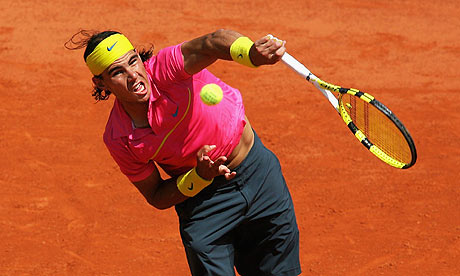
Back to Rafael Nadal... it appears he has thankfully abandoned the 3/4-length shorts affectionately called clamdiggers by Dick Enberg which he introduced into male tennis culture with his rise to stardom, as well as his trademark cutoff shirts, in favor of the classic polo shirt and a pair of regular, cut above the knee shorts. He actually donned a great color combo consisting of an electric pink shirt with a slight yellow stripe that matched his yellow sweat and head bands (seen here )... a vast improvement upon the putrid greens he was so fond of in years past (like this ). The ensembles of Federer, Sharapova and Serena displayed similar healthy injections of bright color, which appears to be the direction Nike is heading with their tennis gear at the present moment.
Having missed out on the Aussie Open and lacking the Tennis Channel, the past fortnight was my first opportunity to watch tennis this year. I was very pleased with Nike's new tennis apparel line, sported by Federer, Nadal, Maria Sharapova, Serena Williams and others. The predominant bright neon colors were a nice foil to the Wimbledon-mandated whitewash we will see in a month or so on the grass of the All England Lawn Tennis and Croquet Club. The all white is actually one of my favorite traditions, very classy, fun to see once a year.
Back to Rafael Nadal... it appears he has thankfully abandoned the 3/4-length shorts affectionately called clamdiggers by Dick Enberg which he introduced into male tennis culture with his rise to stardom, as well as his trademark cutoff shirts, in favor of the classic polo shirt and a pair of regular, cut above the knee shorts. He actually donned a great color combo consisting of an electric pink shirt with a slight yellow stripe that matched his yellow sweat and head bands (seen here )... a vast improvement upon the putrid greens he was so fond of in years past (like this ). The ensembles of Federer, Sharapova and Serena displayed similar healthy injections of bright color, which appears to be the direction Nike is heading with their tennis gear at the present moment.

Intro / Manifesto / Welcome
As a recent college graduate with a degree in English and consequently no career prospects, I hereby launch Deucedbrains with the following objectives:
-to function as a vehicle by which I can explore the fascinating obscurities of the athletic world which often go unexamined by larger media institutions
-to provide an excuse for me to keep up my writing chops in the futile hope that I may one day enter the sportswriting industry
and most importantly
-to attain global fame and fortune
With all of this being said, I would like the opportunity to introduce myself to whoever was unfortunate enough to lay eyes upon my creation. As a remarkably mediocre Division III baseball player, I experienced the most distant and unglamorous margins of the athletic world. Dwelling in the obscurity of DIII athletics provided me with a unique perspective on the world of sports. I have developed a tremendous appreciation for athletes who experience a relative anonymity akin to my own. I find myself curiously magnetized to major league baseball players of little significance from the 1980s to the 1990s A.D., individuals perhaps known more for their proclivity for facial hair growth than their athletic prowess. Otherwise, I am a fan of University of Georgia athletics, the Jacksonville Jaguars, the Atlanta Braves and elitist country club sports, with an unjustifiable yet undying loyalty to the professional golfer David Duval. I delight in mocking others, while simultaneously trying to maintain a healthy sense of self-deprecating humor. I enthusiastically follow past and present uniform trends, especially in college football. Along the same lines, I appreciate athletic fashion from the 1990s with an emphasis on Nike footwear and snapback hats. I also value fresh fits of the contemporary New Era 5950. In closing, it is my hope to somehow communicate and perpetuate these highly specialized and not necessarily related tastes through this fledgling but ambitious establishment, hoping to endear myself to others who do not particularly share my predilections, while also catering to those individuals who might harbor similar fancies.
-to function as a vehicle by which I can explore the fascinating obscurities of the athletic world which often go unexamined by larger media institutions
-to provide an excuse for me to keep up my writing chops in the futile hope that I may one day enter the sportswriting industry
and most importantly
-to attain global fame and fortune
With all of this being said, I would like the opportunity to introduce myself to whoever was unfortunate enough to lay eyes upon my creation. As a remarkably mediocre Division III baseball player, I experienced the most distant and unglamorous margins of the athletic world. Dwelling in the obscurity of DIII athletics provided me with a unique perspective on the world of sports. I have developed a tremendous appreciation for athletes who experience a relative anonymity akin to my own. I find myself curiously magnetized to major league baseball players of little significance from the 1980s to the 1990s A.D., individuals perhaps known more for their proclivity for facial hair growth than their athletic prowess. Otherwise, I am a fan of University of Georgia athletics, the Jacksonville Jaguars, the Atlanta Braves and elitist country club sports, with an unjustifiable yet undying loyalty to the professional golfer David Duval. I delight in mocking others, while simultaneously trying to maintain a healthy sense of self-deprecating humor. I enthusiastically follow past and present uniform trends, especially in college football. Along the same lines, I appreciate athletic fashion from the 1990s with an emphasis on Nike footwear and snapback hats. I also value fresh fits of the contemporary New Era 5950. In closing, it is my hope to somehow communicate and perpetuate these highly specialized and not necessarily related tastes through this fledgling but ambitious establishment, hoping to endear myself to others who do not particularly share my predilections, while also catering to those individuals who might harbor similar fancies.
Subscribe to:
Comments (Atom)